

REPCORE® NATIONS 2026 WEBINAR PRESENTATION
The Reputation of the World’s 60 Largest Economies Declines in 2026
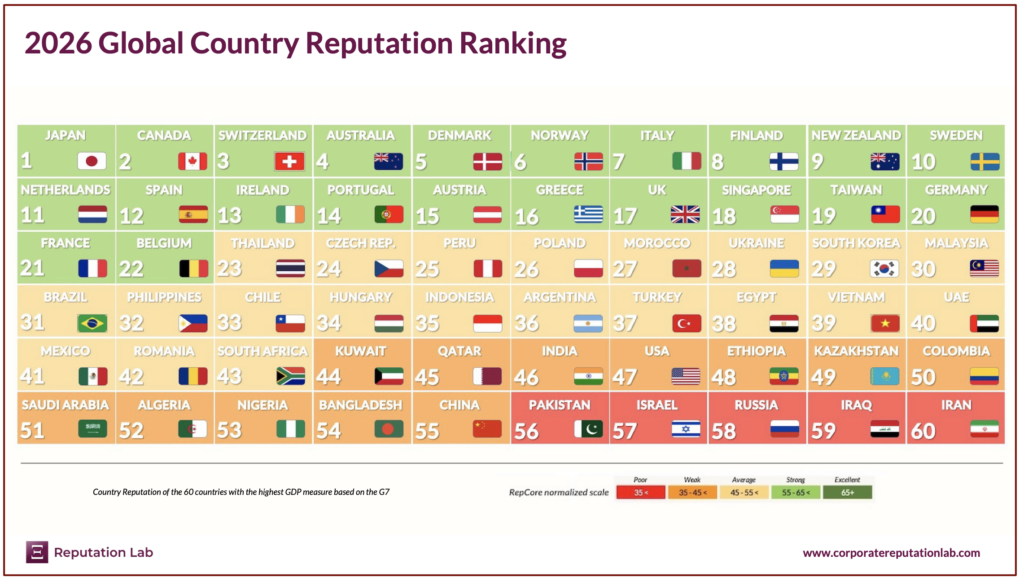
Japan rises to the top of the RepCore® Nations ranking after climbing seven positions and overtaking Canada and Switzerland
- Japan, China, and Russia are the countries that improve their international reputation the most, although China and Russia still remain at weak or poor levels.
- Stable democracies continue to dominate the top of the ranking, led by Japan, Canada, Switzerland, Australia, and Denmark.
- Israel records the sharpest reputational decline in the analysis: since 2022, it has lost 15.8 points and fallen 20 positions in the ranking.
- The new Made-In Score confirms that a country’s reputation directly influences trust in its products and services, as well as consumers’ willingness to pay more for them.
June 4, 2026.– RepCore® Nations 2026 confirms a broad decline in countries’ international reputation. The analysis, produced by Reputation Lab based on public opinion across the G7, shows that the average reputation of the world’s 60 largest economies fell by 0.86 points compared with the previous year.
Of the 60 economies analyzed, 43 saw their reputation decline, 14 improved, and only 3 remained stable.
The results were presented yesterday in an international webinar organized by City Nation Place from London.
Japan Takes the Global Lead
In 2026, Japan rises to first place in the global ranking after climbing seven positions from the previous year and overtaking Canada and Switzerland. The result reflects a clear improvement in its international perception and strengthens its standing across several of the attributes assessed by RepCore® Nations.
Alongside Japan, the top positions continue to be dominated by stable democracies capable of generating high levels of admiration, respect, and trust internationally.
The Erosion of Countries’ Reputation
Japan, China, and Russia are the countries that improve the most over the past year, although China and Russia still remain at weak or poor reputation levels among citizens in the world’s most developed economies.
In contrast, Israel records the sharpest reputational decline in the analysis. Since 2022, it has lost 15.8 points and fallen 20 positions in the ranking, reflecting the impact that the evolution of the conflict in Gaza and the spread of regional tensions have had on its perception among G7 public opinion.
Iran, meanwhile, deepens a reputation already ranked among the lowest in the world and moves into last place in the ranking, behind Russia, which had occupied the bottom position in the previous four editions of RepCore® Nations.
Among the major powers, the United States shows no signs of recovery following the sharp setback recorded in 2025 and continues to hold a weak reputation among G7 citizens. The results also reinforce an idea already visible in previous editions: international visibility does not translate into admiration, respect, and trust.
Reputation Continues to Generate Economic Value
RepCore® Nations 2026 reinforces the relationship between reputation and economic value.
According to Reputation Lab estimates, a one-point improvement in the RepScore indicator predicts, on average, a 7.2% increase in tourism revenue value and a 1% increase in foreign direct investment inflows.
Reputation has become a strategic asset for countries. In a context of widespread deterioration in international perception, nations capable of generating admiration, respect, and trust continue to hold significant competitive advantages in attracting tourism, investment, and talent.
The “Made In” Effect: Reputation Also Drives Sales
As the main innovation in this fifth edition, Reputation Lab introduces the Made-In Score, a new indicator that measures the commercial value associated with the country of origin of products and services.
The results show a very close relationship between a country’s reputation and consumers’ willingness to buy its products, trust its companies, or pay more for goods and services associated with that origin.
Japan, Italy, Switzerland, Germany, and Sweden top the global ranking of countries with the strongest “Made In” effects.
In addition, the analysis reveals that 95% of consumers’ willingness to pay a premium price is explained by the country-of-origin effect measured through the Made-In Score.
Morocco and Ukraine: Two Standout Cases of Reputation Management
The webinar also included a discussion on country reputation management featuring Issam Lotfi, Chief Strategic Officer at Morocco’s Institut Royal des Études Stratégiques (IRES), and Maria Lypiatska, Head of Brand Ukraine.
Morocco consolidates its position as the reputational leader in Africa and the Arab world: it ranks 27th globally, rises three places from the previous year, and strengthens indicators linked to technological perception, public resource management, and international sporting achievements.
Ukraine, for its part, maintains a stable overall reputation, while improving on rational attributes related to security, technological development, and a favorable business environment, reinforcing the admiration and international solidarity generated since the start of the Russian invasion.
About the RepCore® Nations 2026 Analysis
RepCore® Nations adapts the RepCore® model—developed to measure corporate reputation—to the context of countries. The analysis evaluates the degree of admiration, respect, and trust a country inspires and explains it through 22 rational attributes spanning economic, political, social, cultural, and environmental dimensions.
The 2026 edition is based on a survey conducted in 36 countries on the reputation of 74 nations, with a total of 124,014 evaluations collected through online surveys. The published ranking includes the 60 largest economies by GDP, as assessed by public opinion in the G7 countries.
Below is a link to watch the webinar recording on the City Nation Place website. The webinar is free; you just need to register to access the recording.